Gym & Strength Beginner Strength

How to Goblet Squat With Perfect Form

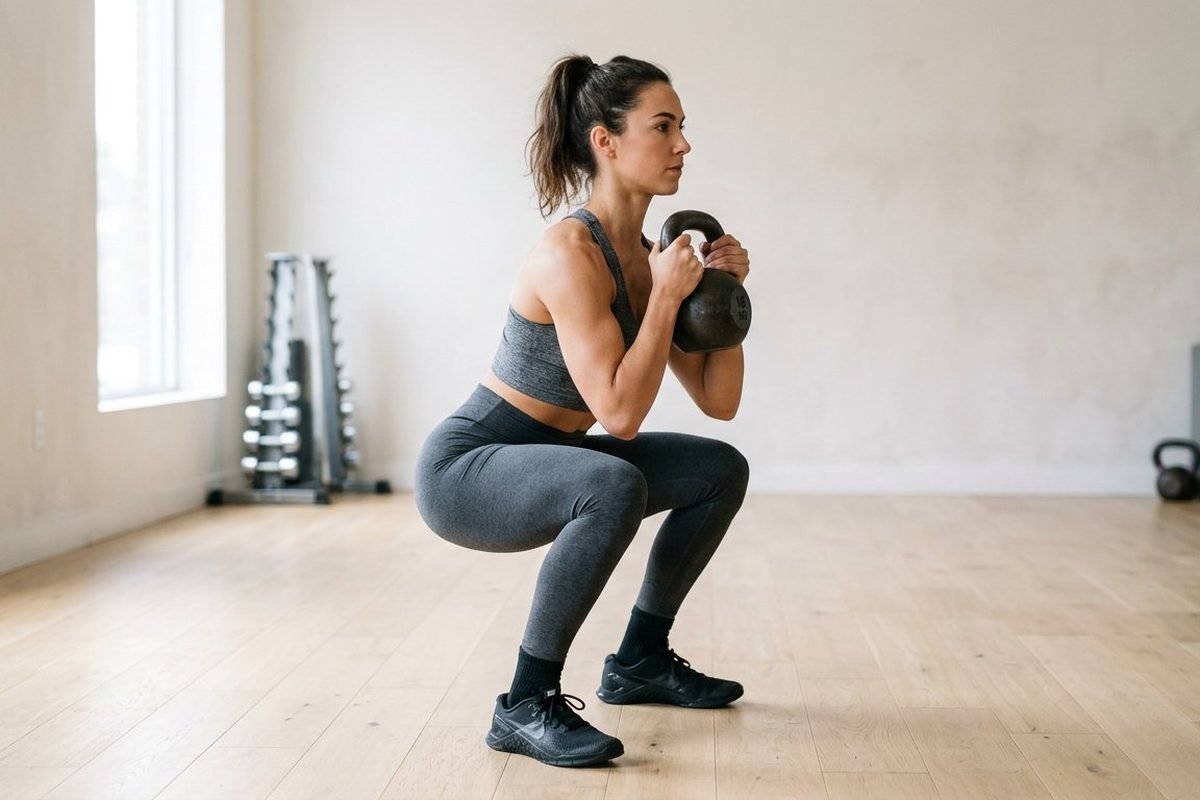
If you only ever learn one strength exercise, make it a squat. It is the movement you use every time you stand up from a chair, and it loads the largest muscles in your body. The goblet squat is the version we teach first, because holding the weight in front of your chest does three useful things at once: it keeps your torso upright, it gives your knees somewhere to travel, and it teaches depth without a coach shouting at you.
3–4 sets of 8–12Volume
60–90 secondsRest
BeginnerLevel
2 seconds downTempo
Jump to instructions
Goblet Squat: The Complete Beginner's Guide

Why this works

A front-loaded weight acts as a counterbalance, so most people reach a full-depth squat with an upright chest on day one instead of fighting a barbell that pushes them forward.

Primary muscles

  • Quadriceps
  • Glutes
  • Adductors

Also working

  • Core
  • Upper back
  • Calves
Goal
Strength
Level
Beginner
Sets & reps
3–4 sets of 8–12
Rest
60–90 seconds
Tempo
2 seconds down, 1 second pause, 1 second up
Est. burn
5–7 per set

Equipment

  • Kettlebell or dumbbell
  • Mat (optional)

Set-up

  1. Stand with your feet about shoulder-width apart, toes turned out 10–20 degrees. Turnout is individual. If your hips feel pinched at the front, widen your stance or turn your toes out more.
  2. Hold a kettlebell by the horns or a dumbbell vertically against your chest. Keep your elbows tucked under the bell, not flared. The weight should feel supported, not gripped.
  3. Brace as if you are about to be poked in the stomach, and take a breath into your belly. A braced trunk keeps your spine neutral and stops your lower back rounding at the bottom.
  4. Set your eyes on a point slightly below horizontal in front of you. Looking up too far arches the neck; looking down pulls the chest down with it.

How to do it, step by step

  1. Break at the hips and knees together

    Push your hips back and bend your knees at the same time, as if sitting into a low chair. Do not start by dropping the hips straight down — that turns it into a knee-dominant squat and stresses the knees.

  2. Let the knees travel forward over the toes

    Your knees will move past your toes. That is normal, safe and necessary for a deep squat. What matters is that they track in line with your second toe rather than collapsing inward.

  3. Descend until your elbows are inside your knees

    For most people that is roughly where the crease of the hip drops below the knee. Go only as deep as you can while keeping your heels down and your back neutral — for some that is full depth, for others it is a half squat on day one.

  4. Pause for one second at the bottom

    This kills the bounce, builds control and gives you time to notice whether your weight has shifted onto your toes.

  5. Drive up through the whole foot

    Push the floor away, keep your chest proud, and finish tall with your glutes squeezed but without leaning back. Exhale as you stand.

Common mistakes (and how to fix them)

Heels lifting off the floor

Ankle stiffness, not "tight calves" in a vague sense. Elevate your heels on two small weight plates or a book, and add ankle mobility work before your next session.

Knees collapsing inward

Usually glute strength. Cue yourself to "spread the floor" with your feet, or loop a light resistance band above your knees and push out against it.

Lower back rounding at the bottom

You are going deeper than your current control allows. Reduce depth to the point where your spine stays neutral, and build range over a few weeks.

Coaching cues & progressions

  • Start lighter than feels impressive. A 12 kg bell done with perfect positions for a year beats a 24 kg bell done badly for a month.
  • Slow the descent to three seconds for a week if you cannot feel your glutes working — tempo teaches control faster than adding weight.
  • If you have knee pain, try a slightly wider stance and a box behind you to sit back to. A target makes range consistent.
  • Two sets of 10 before a run is a genuinely useful warm-up; it wakes up the hips without fatiguing you.

Safety notes

Stop if you feel sharp knee or hip pain, or any pinching at the front of the hip. Muscle effort is expected; joint pain is not. Do not let the weight pull your chest down, and do not bounce out of the bottom. If you have an existing injury, are pregnant, or are returning to exercise after a long break, get clearance from a doctor or physiotherapist before starting.

Suitable for

Frequently asked questions

How deep should I squat?

As deep as you can go while keeping your heels down and your spine neutral. For most trained people that is hip crease below the knee; for beginners it may be less at first. Depth is a skill and improves within weeks.

Are squats bad for your knees?

No. Reviewed evidence consistently finds that well-executed squats do not damage healthy knees, and are used in rehabilitation for knee pain. Poor alignment, sudden load increases and ignoring pain are the risk factors — not the movement.

How often should I do them?

Two to three times a week is ideal for beginners. Leave at least one day between lower-body strength sessions so you recover.

Goblet squat or barbell back squat?

Goblet first — it teaches the pattern with less spinal load and no need for a rack. Move to a front squat or back squat once you can goblet squat 25–30% of your bodyweight for 12 controlled reps.

Can I do this while pregnant?

Generally yes, with modifications. Avoid deep range in late pregnancy if it feels uncomfortable, widen your stance, and use a box behind you. Get clearance from your midwife or physiotherapist first.

Dr. Nadia Haddad

Writes and coaches for MoveWell. Every guide is reviewed by Dr. Erik Lund, PT before publication, and updated when the evidence changes. Read more about our team and review process →

Related guides

All exercises

One workout, every Sunday

A single programmed session for the week ahead, one technique explainer, and the reader question worth answering. Written by our coaches — no supplement ads, no 5am rhetoric.

Thanks — check your inbox to confirm. You can unsubscribe in one click.

By subscribing you agree to our privacy policy. 31,000 readers, no spam.