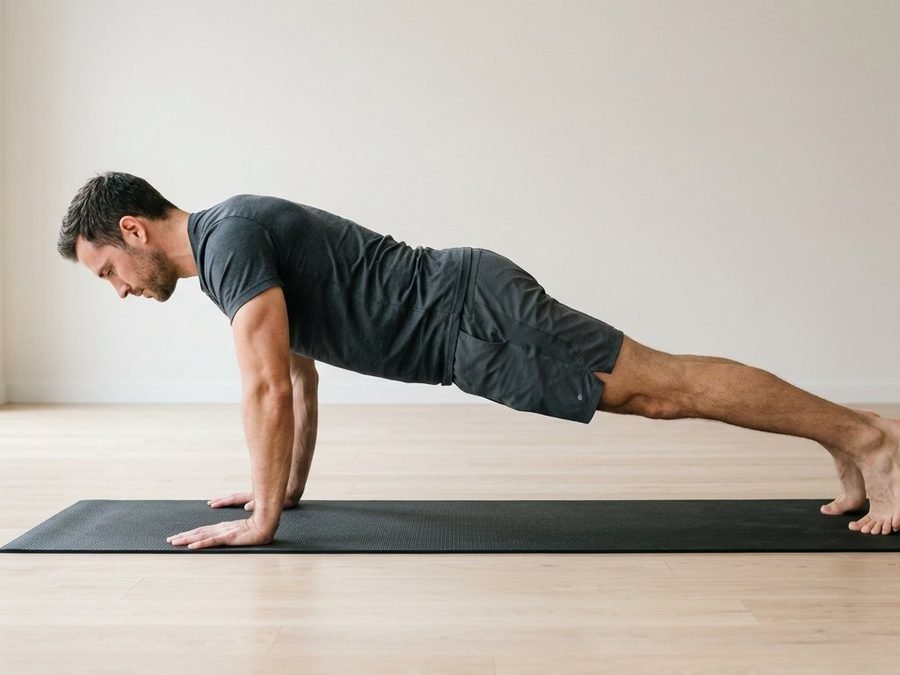
Cardio & HIIT Beginner Conditioning

HIIT Intervals for Beginners (Low-Impact Version)

HIIT gets sold as the efficient route to fitness, which is half true and half marketing. Intervals are genuinely time-efficient for cardiovascular fitness, but they are also the easiest thing to overdo — and most beginners do far too much, far too hard, far too often. This version is deliberately moderate: thirty seconds hard, sixty seconds easy, eight rounds, and a low-impact alternative for every movement.

8 rounds × 30 sec work / 60 sec easyVolume
60 seconds of easy movement between roundsRest
BeginnerLevel
Hard but repeatable — never maximalTempo
Jump to instructions
HIIT for Beginners: Intervals That Don't Wreck You

Why this works

Thirty-second efforts with twice as much recovery let you produce genuinely hard work while keeping total fatigue manageable — that is what builds the heart and lungs without wrecking the joints.

Primary muscles

  • Heart
  • Lungs
  • Legs

Also working

  • Core
  • Shoulders
Goal
Conditioning
Level
Beginner
Sets & reps
8 rounds × 30 sec work / 60 sec easy
Rest
60 seconds of easy movement between rounds
Tempo
Hard but repeatable — never maximal
Est. burn
180–240 total

Equipment

  • Mat
  • Timer
  • Optional: bike or rower

Set-up

  1. Warm up for five minutes, building to a light sweat. Walk, cycle or march in place. Intervals on cold muscles are how people pull things.
  2. Decide your work movement before you start. High impact: jump squats or burpees. Low impact: fast squats, step-ups, or cycling. Pick one for all eight rounds — variety inside a session is a distraction.
  3. Set your timer to 30 seconds hard / 60 seconds easy, eight rounds. The easy period is active recovery: walk, do not sit down.
  4. Set your effort ceiling: you should be able to say three or four words but not a sentence at the end of a work interval. If you are gasping and unable to speak at all, you are working too hard to complete eight rounds with any quality.

How to do it, step by step

  1. Round structure: 30 seconds of hard work

    Hard means 'sustained effort you could repeat eight times', not a sprint. By round four you should still be holding the same speed as round one — if you are not, your first rounds were too fast.

  2. 60 seconds of easy active recovery

    Walk, breathe through your nose if you can, and let your heart rate come down. Do not stretch aggressively mid-session.

  3. Repeat 8 rounds (12 minutes of intervals)

    That is enough. Total session including warm-up and cool-down is about 20 minutes.

  4. Cool down for three minutes and finish with two minutes of easy breathing

    Walk until your breathing is comfortable, then sit and breathe in for four, out for six.

Common mistakes (and how to fix them)

Going all-out in round one

The classic HIIT mistake. Rounds 1–2 should feel almost easy, so rounds 6–8 are still good quality.

Skipping the warm-up

Two to five minutes of easy movement measurably reduces injury risk and improves performance. Not optional.

Turning every session into HIIT

Two sessions a week, maximum, for most people. Three is for trained athletes — and they are not also lifting heavy four times a week.

Coaching cues & progressions

  • Low-impact does not mean low-effort. Fast step-ups or hard cycling intervals raise your heart rate just as effectively as jumping.
  • Track your rounds rather than your calories. A watch estimate for intervals is off by 30–50%.
  • Never do HIIT the day before a heavy lower-body session. Both put the same systems under strain.
  • If you have not exercised in a year, spend four weeks doing steady walking first. Intervals will still be there.

Safety notes

Stop immediately if you feel chest pain, unusual shortness of breath, dizziness or an irregular heartbeat — and seek medical advice. If you have a heart condition, high blood pressure or are pregnant, clear it with your doctor first. Do not sprint the first round, and do not do HIIT more than twice a week. If you have an existing injury, are pregnant, or are returning to exercise after a long break, get clearance from a doctor or physiotherapist before starting.

Suitable for

Frequently asked questions

How often should I do HIIT?

Twice a week is right for most people, ideally not on back-to-back days. HIIT is a strong stimulus with a long recovery cost, and more is genuinely not better for general fitness.

Is HIIT better than steady cardio?

Neither is better — they do different jobs. Intervals improve VO2 max efficiently; steady zone-2 work builds aerobic base and is far easier to recover from. Most people should do more easy cardio than intervals.

Can I do HIIT if I am overweight?

Yes, with the low-impact options. Choose cycling, rowing, swimming or brisk inclined walking over jumping, and build up gradually. The cardiovascular benefit is the same; the joint load is not.

Why do I feel nauseous afterwards?

Usually going too hard too early, being under-fuelled or dehydrated. Reduce the work intensity to 'hard but repeatable' and eat something light 90 minutes beforehand.

Is HIIT safe for teenagers?

Yes, with bodyweight movements and sensible progression. Avoid maximal sprint work until late teens, emphasise technique, and keep it fun rather than punishing.

Marcus Feld

Writes and coaches for MoveWell. Every guide is reviewed by Dr. Erik Lund, PT before publication, and updated when the evidence changes. Read more about our team and review process →

Related guides

All exercises

One workout, every Sunday

A single programmed session for the week ahead, one technique explainer, and the reader question worth answering. Written by our coaches — no supplement ads, no 5am rhetoric.

Thanks — check your inbox to confirm. You can unsubscribe in one click.

By subscribing you agree to our privacy policy. 31,000 readers, no spam.